Robert Harrington

Robert Harrington

Graduate Research Fellows
Year
1995

Hydrology/Water Resources (1 year award)

Bob's Space Grant outreach project: I'm organizing a presentation for K-12 grades on water. It covers some show-and-tell type physics (polarity, dissociation, phase changes, latent heat), plus some basic hydrology such as the hydrologic cycle, ground water flow, water quality, and ecology. I'm also assembling some scientific review documents regarding the San Pedro Basin, with the intent of being able to put together a field trip to the San Pedro sometime this spring.

Stephen Brod

Stephen Brod

Graduate Research Fellows
Year
1995
1996

Space Engineering Research Center (SERC) (2 year award)

Steve Brod is a graduate student in Aerospace and Mechanical Engineering. His award is co-sponsored by the University of Arizona's Space Engineering Research Center (SERC).

Steve describes his outreach project as follows: Our lives are dominated by technology. Science is the key to understanding that technology. My project, the writing of a short book for kids, attempts to make the connection between the science learned in the classroom, and the way we use that science everyday. I also want to demonstrate the science we use everyday is the foundation of all science, including the front page sort of stuff that everyone thinks is so great. (My hope is, of course, that students will think that the everyday stuff is exciting, not that the exciting stuff is now boring.)

Kostya Nakazny

Kostya Nakazny

Graduate Research Fellows
Image
Nakazny, Kostya
Year
2011

I am in my second year of the Masters program in Educational Psychology at the University of Arizona. My greatest interest is in technology enhanced learning environments in the STEM fields. I work closely with my institutional partner, the Arizona Sonoran Desert Museum (ASDM) and its Education Director to design and develop an online student built interactive web based portal. The interactive portal allows teachers to easily manage classes, create groups, and evaluate students’ work. Students use NASA aerial and satellite temporal images and other resources to investigate a geographical area on such topics as water resources, urban heat islands, wild fire impact, and others. Once an investigation is complete the students report significant findings and present before/after images of the area using intuitive tools of the interactive web based portal.

I will develop 2 or 3 complete lesson plans that will cover topics such as water cycle, urban water use, wild fires in Arizona and others (the exact topics will depend on the needs of the ASDM). The lesson plans will be project-based and include the latest findings in educational research.

My previous experience in working on technology enhanced learning environments and what I learned in the first year of my Masters program lead me to believe that it is very important to understand how teachers evaluate and use available technology for educational purposes. I am developing a questionnaire that will shed light on the process teachers go through when evaluating technologies for educational purposes. The design and functionality of the web portal and the findings from the answers to the questionnaire will form part of my Maters thesis. 

Monica Ramirez

Monica Ramirez

Graduate Research Fellows
Image
Ramirez, Monica
Year
2010
2011

Monica will be working with the US Environmental Protection Agency, Arizona Department of Environmental Quality and the towns of Dewey-Humboldt, Arizona to determine the quality of vegetables grown in home gardens neighboring the Iron King Mine and Humboldt Smelter Superfund Site (IKMHSS).

Monica has developed the Gardenroots project is in response to community concerns regarding the quality of produce from home gardens. She will be working with local vegetable gardeners to determine if their soils and vegetable gardens have been impacted by the mine tailing waste from the IKMHSS. Monica will carry out a citizen science program that will actively engage community members in the sampling collection process and in the design of project's outreach materials. Citizen Scientists of the Dewey-Humboldt, Arizona area will be:

  • Trained in how to collect water, soil and vegetable samples from their gardens for micronutrient and metals analyses,
  • Better informed regarding the quality of the vegetables they grow, and issues related to soil and water quality in Arizona and the Southwest US; and
  • Empowered, as they will communicate the information revealed by the project and be ambassadors for the environment in their community.

Melissa Merrick

Melissa Merrick

Graduate Research Fellows
Image
Merrick, Melissa
Year
2010
2011

My outreach program aims to incorporate San Carlos Apache high school students participating in the Bylas and San Carlos summer youth program, sponsored by Mount Graham International Observatory, in my doctoral research on the process of natal dispersal and settlement in federally endangered Mt. Graham red squirrels. My goal is to provide important hands-on experiences with spatial technologies such as radio telemetry, map and compass, GPS, GIS, and remotely sensed imagery for students to help us understand what landscape features influences where juvenile red squirrels explore and eventually settle. In the field we will see different squirrel behaviors, forest types, and conditions, and in a GIS we will be able to examine home ranges and other spatial data such as roads, fires, and forest damage due to tree death, that may impact squirrel space use. I will use hands-on, inquiry-based approaches to field study in combination with visiting speakers from federal agencies and universities to instill excitement about ecological research and increase appreciation regarding the value of STEM-based education, particularly among students traditionally underrepresented in STEM fields.

Timothy Bayley

Timothy Bayley

Graduate Research Fellows
Image
Bayley, Timothy
Year
2010
2011

Before beginning my PhD in Hydrology and Water Resources, I taught junior high science at a Title I school in Phoenix, Arizona as a Teach For America corps member. During the two years that I was teaching, I saw the disparity in educational opportunity that exists between low-income school districts and their wealthier counterparts. There are many systemic and social issues that contribute to this disparity. One factor contributing to this gap is the lack of exposure to applied math and science in low-income areas. For my NASA Space Grant Fellowship I am developing state standard aligned lesson plans that will expose high school students to science that is being conducted in Arizona. My hope is that this program will give students a vision for the type of work that they could be involved in if they pursue a career in the sciences and that the context of real research will provide meaning to classroom studies.

University of Arizona and NASA scientists are involved in many cutting edge projects that apply to the world around us. University of Arizona led projects such as the Biosphere 2, Critical Zone Observatory, the University of Arizona weighing lysimeter facility, and COSMOS all have components that relate directly to Arizona high school science standards. These projects are a great opportunity to put Arizona science standards into context for Arizona students while highlighting the work being done by University of Arizona and NASA scientists.

The lessons that I am developing each have interactive or lab based projects that follow a theme, such as evapotranspiration or soil moisture. They are also directly applicable to required high school science classes such as biology and physics. Lessons each include pre-lab reading assignments, lab modules, homework assignments, in-class videos featuring UA/NASA scientists, standards aligned teaching guides, and rubrics for grading assignments. All materials will be hosted on a Biosphere 2 website and will be accessible to teachers online. After students have worked their way through the in-class lessons and have acquired a basic set of knowledge, they will participate in a field trip to Biosphere 2. At Biosphere 2, students will be able to interact with ongoing work being conducted by UA scientists. Field trip activities will directly relate to the knowledge learned through classroom activities. These lessons will be used by Biosphere 2 as their permanent high school field trip program. The expected impact of this work extends far beyond the project development timeline, hopefully impacting many students.

Rebecca Lybrand

Rebecca Lybrand

Graduate Research Fellows
Image
Lybrand, Rebecca
Year
2013

Rebecca is a 4th year Ph.D. candidate in the Department of Soil, Water and Environmental Science, with a minor in Remote Sensing and Spatial Analysis. Her research is focused on changes in soil development and soil carbon storage across contrasting climates and landscape positions. Rebecca’s field sites are located in the Santa Catalina Mountains of southern Arizona, where her sites span desert scrub to mixed conifer forest.

Rebecca is committed to science education outreach and has volunteered as an i-STEM mentor since 2012. The i-STEM hybrid mentoring program is focused on broadening the participation of underrepresented groups in STEM education programs and careers. i-STEM employs a combination of in-school, hands-on science activities and informal, out-of-classroom science field trips to stimulate interest and knowledge of STEM fields. Mentors recruited from the Tucson community are paired with 3rd-8th grade students from local schools. This NSF-funded initiative is committed to evaluating the program’s effectiveness on Native American and Hispanic student academic performance and science retention.

Rebecca is developing Space to Soils modules for use by i-STEM mentors and mentees as her UA/NASA space grant educational outreach project. The Space to Soils modules aim to integrate applied, technology intensive activities using satellite imagery to explore the Earth’s surface from space with a closer, hands-on examination of the soils encountered in everyday life. Rebecca’s goal is for i-STEM mentees to be engaged in the world’s interconnectedness from the expanses of space science to the intricate details of soil science. Mentees and mentors will also be taking a field trip to the University of Arizona’s Campus Agricultural Center where they will participate in a combination of space and soils related activities including the exciting exploration of soil pits!

The educational materials developed for the i-STEM hybrid mentoring program will be made publicly available for use by K-12 teachers and educators worldwide. 

Jason Davis

Jason Davis

Graduate Research Fellows
Image
Davis, Jason
Year
2013

My NASA Space Grant project is a documentary film called Desert Moon. In 1961, President John F. Kennedy declared humans would walk on the moon before the end of the decade. But at the time, scientists knew very little about the moon—including whether the surface was solid, or a thick layer of dust that would swallow a spacecraft.

Desert Moon explores the creation of the University of Arizona Lunar and Planetary Laboratory. The lab, founded by astronomer Gerard Kuiper, played a critical role in constructing the first photographic lunar atlases in support of the Apollo moon landings. Kuiper’s team also participated in the Ranger program, an effort to send America’s first unmanned spacecraft to the moon.

The film features interviews with current and retired UA planetary scientists, and contains archival photos and videos from the lab’s early days. Desert Moon debuts at Flandrau Science Center in 2014.

I am a University of Arizona journalism master’s student specializing in science writing. Last year, I created Scientific Tucsonan, a digital science journalism magazine for iPad. I was the Wick Science Communications Intern for Green Valley News. I am also a contributing editor for the Planetary Society, a non-profit space advocacy group co-founded by Carl Sagan and currently led by Bill Nye.

Documentary Explores How the UA Helped Land a Man on the Moon

Michelle Coe

Michelle Coe

Graduate Research Fellows
Image
Coe, Michelle
Year
2013
2014

Michelle Coe: My NASA Space Grant Graduate Fellowship involves incorporating Manzo Elementary's restoration ecology program into the classroom. I am doing this by implementing projects occurring at Biosphere 2's Landscape Evolution Observatory (LEO) into Manzo Elementary's greenhouse. One of Manzo's 4th grade classes will be learning and replicating projects happening at the LEO site, as well as visiting the Biosphere 2 twice during the school year. Projects occurring in Manzo and LEO's greenhouses will include hypothesizing, data collection, and analyzing native seedlings planted on LEO soil. Furthermore, we will be looking at variables such as variation in aspect, temperature, and soil moisture as these variables may occur in a natural landscape. This will help the children get a sense of how their research and projects can relate to science on a larger scale (both in terms of the LEO project and climate change projections), as well as allow a new and innovative area for math, science, and English skills to be incorporated into their curriculum. The classroom outline at Manzo Elementary includes 1 hour lesson plans and 2 hours in the greenhouse each week, where the children review concepts, collect data, and learn vocabulary focused on climate change, landscape, vegetation and more.

Read More

The Arizona Space Grant Consortium is proud to support this impressive STEM education program at Tucson’s Manzo Elementary school through the efforts of UA Graduate Fellow Michelle Coe. Michelle speaks about her program with Manzo students in a PBS AZPM video segment.

Video from "Local Kids Benefit from Nationally Recognized Ecology Program" by Mitchell Riley

Read More

Fall 2014 Update
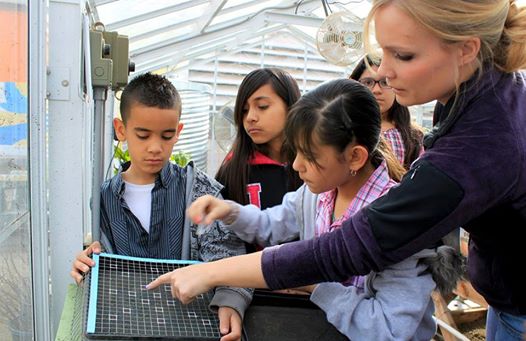
Manzo Elementary School in Tucson, Arizona is an innovator in using reconciliation ecology as a tool to offer experiential learning and address children’s behavioral issues. Their ecology program has improved and supported the school’s larger educational objectives by enabling students to be more inclined to learn. In January of 2012, Manzo received the U.S. Green Building Council’s “Best Green School” award. Despite impressive infrastructural innovations and accolades, teachers have yet to fully embrace the opportunity to link classroom teaching to the multifaceted aspects of the ecology program. To address this disconnect, this program connects the science students are learning in weekly sessions at Manzo to scientific experiments occurring at Biosphere 2 (B2) in Oracle, Arizona. Manzo Elementary has partnered with B2’s flagship experiment by reproducing a model Landscape Evolution Observatory (LEO) within Manzo’s greenhouse, testing what types of seeds and saplings will grow in the observatory’s soil. The goal is to create experiential learning programs appropriate for the classrooms that have real and tangible benefits for ongoing research. In so doing, a win-win-win scenario is created: (i) Manzo students conduct science, mathematically process results, and write reports based on their work; (ii) B2 scientists receive augmented datasets about the early ecology of Landscape Evolution Observatory soils; and (iii) B2 educators acquire a template for experiential learning that can be adapted for other classrooms in the area. These activities connect students to contemporary climate change problems such as climate variability and drought and are synchronous with the development of Tucson Unified School District (TUSD) science and math skills. As the second year of this program begins, we have begun working with Ms. Norma Gonzales’ 3rd grade classroom at Manzo Elementary. We hope to expand the mini LEO project and curriculum to other schools within TUSD at the beginning of January, 2015 with help from graduate student assistants from the University of Arizona and the School and Community Gardening Program. 

Sophia Chen

Sophia Chen

Graduate Research Fellows
Image
Chen, Sophia
Year
2013
2014

I am a first-year physics Ph.D. student at the University of Arizona, researching utility-scale solar energy in Dr. Alex Cronin’s lab.   I am passionate about environmental issues such as pollution, energy security, and climate change. In addition to their technical elements, I am also interested in the social aspects of these issues, particularly promoting interdisciplinary and cross-cultural communication.  I spent a year in China on a Fulbright fellowship researching coal-related pollution.  While there, I taught environmental awareness classes to Chinese students to help bridge the gaps between our perspectives.   Outreach—raising environmental awareness and capturing the interest of a new generation of scientists—is essential to this line of work.  The Space Grant allows me to communicate with different groups of people about these environmental issues.

I help organize and coordinate a high school solar go-kart competition run by Tech Parks Arizona at the University of Arizona Tech Park called Racing the Sun (RTS).  The program is in its third year, and participating schools come from all over Arizona, including Tucson, Phoenix, and Monument Valley areas.  Students design, build, and race solar-powered go-karts under the mentorship of two high school teachers.  The participants gain skills in electronics and engineering in a fun, hands-on setting.  In the spirit of interdisciplinary education, the program also has an entrepreneurial component:  the students fundraise the cost of the go-kart.  I connect academics and industry professionals to mentor these high school students, and I help to organize and teach workshops.  The program seeks to promote interest in STEM and to help students begin to develop the skills necessary for such careers.