Vuna Fa

Vuna Fa

Graduate Research Fellows
Image
Fa, Vuna
Year
2006
2007

Vuna Fa, co-sponsored by the University of Arizona Department of Immunobiology

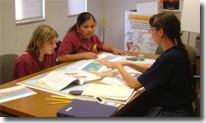
Research in biotechnology has grown to encompass almost any imaginable field of scientific research ranging from the science of space exploration to the treatment of disease. Biotech research will undeniably continue to shape our world and ultimately lead to more fascinating discoveries. However, current tools and techniques used in biotechnology can seem both complicated and intimidating to many middle and high school students and even some teachers. This is particularly true if the students do not have a clear understanding of basic science. After a discouraging personal experience with the sciences in high school, I never imagined myself capable of doing anything science-related. As a business major in college my child was diagnosed with a prenatal heart condition exposing me to the world of medicine and ultimately medical research. Today, I am an immunology graduate student studying T cell development including how thymic T cells develop in microgravity. I believe that presenting the basic science behind current scientific techniques, along with the history and people behind them, in a hands-on and entertaining way will help these students to become more scientifically literate and may even be that “eye-opening” experience that leads some students to consider science as a career. My education outreach project consists of 4 presentations called Biotech Labs that present various topics including the race to discover DNA structure, DNA analysis, how diseases are discovered and treated, and why gravity is such a big deal. My target audience for these presentations are students traditionally underrepresented within the science field including underrepresented minorities, students from low-income homes, and students that would be first generation college graduates. Initially, I present these interactive Biotech Lab presentations in science classes after meeting with the teachers to help them prepare their class and to determine the level and needs of the class. I am also developing material for the teachers so that they can continue these Biotech Labs on their own in subsequent years. I am working with various charter and public schools in the Casa Grande, Coolidge, Tucson, and surrounding areas. I am also working on a website that will make these presentations and related material and links available to any teacher or student.

The NASA/UA Spacegrant fellowship is helping me to realize one of my true joys in teaching as well as helping young students to gain greater confidence and understanding with respect to scientific discovery.

Andrew Shaner

Andrew Shaner

Graduate Research Fellows
Image
Shaner, Andrew
Year
2005
2006

Andrew Shaner, co-sponsored by the University of Arizona Lunar and Planetary Lab Phoenix Mission

MarsBots Curriculum Development

Partnering with NASA’s Science, Engineering, Mathematics and Aerospace Academy (SEMAA) and the Phoenix Mars mission’s E/PO program, I am creating a comprehensive, national standards-based curriculum package out of a set of grades 1-4 robotics activities which had been aligned with Arizona state standards. This curriculum will align with national science, technology, mathematics, reading, and writing standards. The activities were developed and/or adapted by two master teachers – Katy Wilkins of Central Arizona College (CAC) and Mary Lara, a NASA Solar System Educator teaching at DeMiguel Elementary School in Flagstaff, AZ – both of whom serve as my mentors on this project. Three camps were held over summer 2005 to validate the curriculum’s activities. After each camp, revisions were made to the curriculum based off of lessons learned during camp instruction. Final revisions are currently being made to the curriculum in preparation for review by CAC and Phoenix E/PO staff for educational efficacy and technical accuracy.

Fall 2006 Update

The MarsBots robotics learning module passed NASA’s education review in the spring of 2006. After addressing comments from the review committee, the module went on to the Mars Public Engagement Program at the Jet Propulsion Laboratory. After review from MPEP, the module will go on to NASA’s communications review. If approved at the communications review, the module will become a part of NASA’s portfolio of education products. Also following review at MPEP, the module will be submitted to NASA’s Science, Engineering, Mathematics, and Aerospace Academy to be incorporated as a supplement to their existing robotics curriculum. Currently, the entire module can be found on the Phoenix mission website:http://phoenix.lpl.arizona.edu/classroom.php.

MarsBots was distributed at teacher workshops conducted last year at various sites across the country including Sally Ride festivals at Arizona State University and Cal Tech, workshops in Kansas, Tennessee, and the National Science Teachers Association’s annual conference. Follow-up emails were sent out to the over 100 participants of these workshops. These emails asked participants whether or not they have used MarsBots activities in their classrooms and what impact it appeared to have on their students. To date, no responses have been received from participants. For one week in June 2006, the Phoenix mission sponsored a teacher workshop in Fairbanks, AK. During the workshop, 18 teachers from the U.S. and two from Canada were exposed to the MarsBots learning module as well as other Mars curricula and activities. After the workshop these teachers became education ambassadors to their local communities for the Phoenix mission. Some of these teachers have done workshops featuring activities from the learning module. The activity “Mars Match Game” has been used by the Phoenix mission E/PO team at numerous outreach venues.

In 2007, more MarsBots workshops will be conducted as the launch of the mission approaches (August 3, 2007). Tentative workshop locations include Wichita, KS, New Orleans, LA, and Florida.

Shoshana Mayden

Shoshana Mayden

Graduate Research Fellows
Image
Mayden, Shoshana
Year
2005
2006

Shoshana Mayden, co-sponsored by the University of Arizona Department of Geography and Regional Development and the Institute for the Study of Planet Earth

Climate variability and change has a great influence on the livelihoods of the people in the Desert Southwest, impacting areas such as agriculture, water supplies, tourism, energy production, and human health. Newspapers are a powerful and effective medium for reaching both everyday citizens and decision makers. However, while weather stories are frequently front-page news, the underlying climate dynamics are often absent or sometimes misrepresented— particularly in smaller newspapers that don’t have dedicated science or environmental reporters

My outreach project seeks to establish a climate education program for journalists, with the ultimate goal of better informing the public on these issues. The initial plans are for a series of short (1-1.5 days) workshops where journalists will partake in hands-on learning activities, real-time data demonstrations, question and answer sessions with scientists, and a trip to the “field” to see climate science in action. Although it will be challenging in a short workshop, I hope to develop a curriculum that will engage participants in scientific inquiry and processes, rather than presenting an overwhelming amount of facts. The journalists participating in the workshops will walk away with a stronger knowledge base regarding climate variability and change to draw from during breaking news stories, as well as new ideas about data (including NASA products) and expert sources that can inform their future work.

I am fortunate to be partnering with two mentors from existing outreach-related programs at the University of Arizona: Gregg Garfin, Program Manager of the Climate Assessment for the Southwest (CLIMAS) project, and Arizona Cooperative Extension Specialist Mike Crimmins. Both are currently involved in a joint effort to produce climate and drought information targeted to the general public in Arizona and New Mexico and are interested in developing a permanent media outreach program. They are aiding in workshop planning, as well as in the development and presentation of educational materials.

The plan for fall 2005 is to workout logistical details and to begin planning the workshop curriculum. The initial workshop, planned for February 2006 (final date TBD), will target Arizona print media with efforts to include journalists in under-served communities (Hispanic and American Indian). Subsequent workshops (planned for fall 2006 and spring 2007, contingent on funding) may grow to include journalists from other parts of the country. We have decided to focus primarily on climate change and I am completing graduate coursework on the climate system this semester that will aid in developing a module on the climate effects of global warming in Arizona. We have put together our initial workshop budget and solicited funds from Cooperative Extension and NOAA. I am also spending time investigating successful media outreach programs at other institutions and looking at the academic literature on how journalist perceive and portray climate change issues. This will be followed by an analysis of newspaper articles regarding climate change from the Southwest and an initial survey of invited participants.

Fall 2006 Update

Shoshana MaydenOne goal of the project is to develop a curriculum that will engage participants in scientific inquiry and processes, rather than presenting an overwhelming amount of facts. To this end, I created a web module demonstrating how climate change may already be increasing winter minimum temperatures at several locations around the state that allows users to ask questions and explore climate data. This module was coupled with other hands-on activities at the workshop, including a visit to the UA Laboratory for Tree-Ring Research to see how the varying annual bands of trees hold clues to the climate of the past and an interactive presentation of the online vegetation-monitoring tool, Arizona RangeView.

Mayden, ShoshanaFor 2006-2007, we are planning a second workshop to be held in northern Arizona and will possibly extend the outreach program to editors, publishers, and journalism students. As part of graduate seminar on climate change, I am working with other students to analyze the latest climate change projections and determine how they will influence the Southwest. The information from the class will fuel some of content for the next workshop and I will also be aiding in developing website content for the public based on the results. I am continuing to refine the web module developed in the first year of the project and am working with a professor at Pima Community College who plans to use it her biology/environment courses. My final goal for the project is to develop a website that will be a permanent resource for journalists writing about climate change issues.

Serina Diniega

Serina Diniega

Graduate Research Fellows
Image
Diniega, Serina
Year
2005

Serina Diniega, co-sponsored by the University of Arizona Applied Mathematics Program

I believe that many students lose their interest in mathematical and scientific studies primarily because they do not learn the main lessons of these subjects -- different ways to approach and solve problems. Once these lessons are learned, mathematics and science classes and studies are no longer "useless", obtuse, and/or boring, but instead are potentially inspirational opportunities for a student to practice important skills in observation and problem solving.

Serina DiniegaIn this project, these lessons are taught to middle school students through the study of planetary surfaces; this is an area of study where detailed knowledge of complex processes is not necessary. On a daily basis, everyone deals with local topography and changes in that planetary surface, on many different scales. Thus, a basic understanding of how planetary surfaces form and are altered can be almost "intuitional", requiring only the ability to ask the right questions and to logically apply observations and knowledge.

Serina DiniegaI am developing curriculum materials that can be used with students in the 6th-8th grade. These lessons fulfil some of the state and national education requirements in math and science, and involve a mix of hands-on activities, lectures, and multimedia tools. In the Fall term, I am teaching classes through the afterschool program at Hohokam Middle School. In the Spring term, the curriculum materials and my classes will be refined and made available to other students and groups.

To date, this project has received assistance from staff members from Hohokam Middle School and Tucson's Information and Referral Services.

Jodi Perin

Jodi Perin

Graduate Research Fellows
Image
Perin, Jodi
Year
2004
2005

Jodi Perin, co-sponsored by the Center for Applied Spatial Analysis [CASA], the Bureau of Applied Research in Anthropology [BARA], and the University of Arizona Department of Anthropology

Science education can be particularly critical for adults who have not finished high school, both because of the necessity of understanding scientific concepts in daily life and because adults need to be engaged in science in order to help and encourage their children’s academic success. My NASA Space Grant project therefore focuses on designing and implementing an introductory science and spatial literacy curriculum for use in adult education courses. This idea came out of my volunteer work with one adult education class near Tucson, Arizona. This class is part of a nation-wide program called Family Literacy, which aims to improve the academic success and well-being of at-risk children and parents through a variety of mechanisms, including adult education classes. Many of the adult students who participate in Family Literacy classes aspire to take the General Equivalency Diploma (GED) exam, which includes a significant science component. Further, GED subject areas in math and social studies also encompass geographic and other science-related concepts and require that students be able to understand and interpret maps, graphs, and charts. However, at the time of writing, the Family Literacy program in Tucson does not have formal science or spatial literacy instruction in its adult education courses.

Perin, JodiAs a Space Grant Fellow, my educational outreach goal is to design and implement a program that will involve adult literacy students in hands-on science exercises in order to increase familiarity with fundamental scientific concepts, computers, and spatial technology. During the 2004-2005 academic year I am focusing on developing and refining this curriculum and on piloting it in one Family Literacy classroom. In the fall of 2004 I worked with Family Literacy instructors and administrators to design the pilot curriculum, and I met weekly with the Family Literacy students who will participate in this program, in order to tutor them in GED subjects and to greater familiarize myself with their interests and abilities. Starting in January 2005 I will pilot the program in twice weekly workshops. The program will last approximately 5-7 weeks and will introduce the students to basic concepts of science and spatial literacy, including reading maps, charts, and graphs, and analyzing and mapping data using computers. At the end of the program, the students, Family Literacy instructors, and I will evaluate the program for ‘lessons learned,’ and I hope to implement the project in four other Family Literacy sites next year and to create a reproducible curriculum that will be available to Family Literacy and other adult educators online.

Fall 2005 Update

Perin, JodiFor the 2005-2006 academic year I have revised the curriculum based on feedback from students and Family Literacy administrators, and I will be running the workshops in four Family Literacy sites this academic year. Based on continued feedback, I will then create a reproducible curriculum that will be available to Family Literacy and other adult educators online.

Roberta McGuire

Roberta McGuire

Graduate Research Fellows
Image
McGuire, Roberta
Year
2004
2005

Roberta McGuire, co-sponsored by the Agricultural Research Service and the University of Arizona School of Natural Resources

Fall 2004

Water is a precious resource in our semiarid region and is in short supply. Land use decision makers need to be kept informed of hydrologic specifics and developments in our state and the impacts of their decisions upon our watersheds.

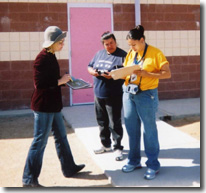
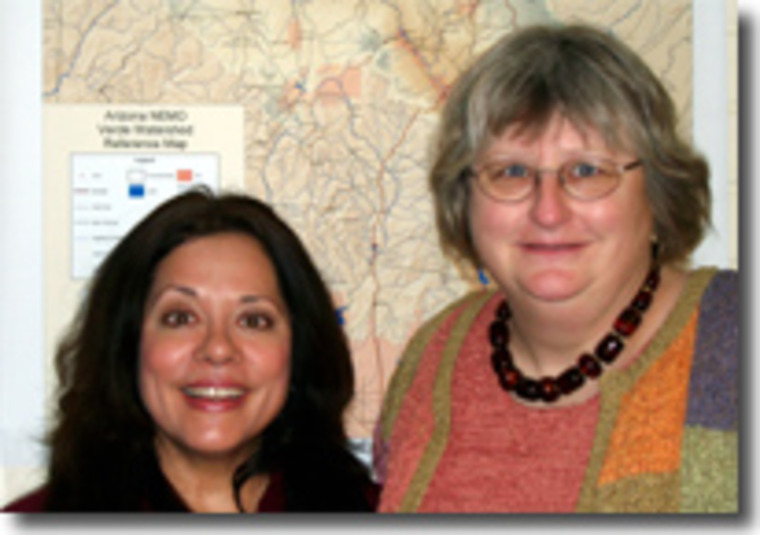
Currently I am involved with Kristine Uhlman (pictured right), the Statewide Coordinator for the Nonpoint Source Education for Municipal Officials (NEMO), an outreach education partnership between the University of Arizona Cooperative Extension and the Arizona Department of Environmental Quality. The NEMO program provides water education to land-use decision makers, municipalities, and other stakeholders to promote restoration, maintenance, and protection of water quality and quantity in watersheds across the state of Arizona.

Central to this program is the use of GIS mapping and modeling which provide visual displays of potential impacts of land use decisions upon water quality and quantity. In addition, we have been conducting hydrologic modeling to simulate impact to watershed response due to land use change, as well as ranking and prioritizing subwatershed areas for grant funding based on vulnerability to water quality degradation. Major watersheds that have been presented are the Bill Williams, Upper Gila and Verde River. We are currently extending the program to other regions of the state. Visit our site at www.srnr.arizona.edu/nemo and learn more about water quality conditions in these watersheds; recommendations for control of pollution sources; and suggestions for management options to protect and improve water quality in our state.

Spring 2005 Update

The condition and quantity of water supplies within rural Arizona are now considered a critical problem. These non-metropolitan communities have already experienced such rapid rates of population growth that existing water supplies and financial resources may be unable to sustain projected future growth. Current estimates by the Arizona Department of Economic Security anticipate a doubling of populations in these areas over the next 50 years. Essentially rural areas have limited water supply alternatives and even more inadequate planning information.

In my education outreach project, I am working with Kristine Uhlman, the Statewide Coordinator for the Nonpoint Source Education for Municipal Officials (NEMO), a program conducted in association with the University of Arizona Cooperative Extension and the Arizona Department of Environmental Quality. The Arizona NEMO program provides water education information to land-use decision makers, municipalities, tribal entities, and other stakeholders to promote restoration, maintenance, and protection of ground water and surface water quality and quantity in rural watersheds across the state of Arizona. This information is presented to all interested parties involved, through town hall meetings and community workshops with additional material also available on our website: http://www.srnr.arizona.edu/nemo

To help encourage active participation in rural watershed planning, my goal is to expand my work with Arizona NEMO through exploration of existing ground water resources available in rural communities. My work continues by incorporating water well data of state rural watersheds onto Arizona NEMO’s website, and assisting in the capacity of liaison between Arizona NEMO and local community town hall meetings, workshops and newspapers. I will work to inform community watershed groups and all interested parties of issues surrounding rural ground water availability and rural water needs. A major concern for rural watershed groups and land managers is the lack of available information on existing ground water resources.

Since our inception in 2004, I have been involved in developing a database of scientific research information, which provided background material to support an active rural watershed education outreach program. This information combined with NEMO maps has been utilized by existing watershed groups and has gained substantial interest and support for Arizona NEMO from rural communities in our state. Jan Holder, program manager of the Upper Gila Watershed Partnership has indicated that Arizona NEMO maps will help the Upper Gila Watershed group learn evaporation and transpiration rates. Knowing these rates will help to evaluate how much water will be available for Graham and Greenlee residents in the future.

We were instrumental, as part of a collaborative effort, in providing resource information to the Upper Gila Partnership that aided in the production of the first draft of a watershed plan and report. We are looking forward to working with the additional watershed groups of the Community Watershed Alliance in the Middle San Pedro Area and Wilcox watershed areas.

As a NASA Space Grant Graduate Fellow, I will continue to work with Kristine Uhlman of Arizona NEMO and become more actively involved in town-hall meetings with regional stakeholders, tribal entities, and community watershed groups to inform and illustrate how this information may be accessed and used for their water planning needs. Additional community workshops will be conducted in these rural areas to discuss and explore assessment of rural ground water supply conditions in relation to rural water needs.

We will continue to encourage participants at these community meetings to exchange contact information and develop their own network infrastructure of information exchange on water supply issues. Town hall meetings will offer an excellent opportunity to encourage individual participants to assume leadership-like roles. These individuals will then be provided with information to host/facilitate additional group meetings on building community support for their own water supply education programs.

My research work for my masters and doctorate both focus upon ground water use characteristics of native riparian versus invasive species along the lower, middle and upper San Pedro River basin areas. I plan to share the results of both my studies and other related research projects to be used as a tool for rural watershed planners in preparing water assessment budgets and preservation of riparian habitats. My work with Arizona NEMO and rural communities has been personally rewarding and I look forward to another year of furthering scientific knowledge of ground water conditions in rural areas and provide needed information and support that will allow all stakeholders and decision-makers involved to make responsible water use choices.

Fall 2005 Update
Roberta McGuireMy project goal for year 2005-2006 is to establish a link between research studies performed by the scientific community and the general public for assistance in water planning. This will be done by effectively summarizing selected research studies conducted within southern Arizona on regional water use by vegetation and convey this information to rural communities. My communication outreach program utilizes a two-fold strategy: (1) Create and design a brochure that contains a synthesis of these results; (2) Distribute this printed information directly to interested stakeholders through Arizona NEMO.
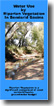
Roberta McGuireScheduled for late Fall, 2005, Arizona NEMO will be distributing a tri-fold color brochure that lists information obtained through scientific research to rural communities. The brochure design (see photo), illustrates water use by dominant vegetation communities in southeastern Arizona. Annual water use by these plants will help stakeholders gain a perspective of the multi-dimensional aspect needed for watershed planning.


Karen Ann Knierman

Karen Ann Knierman

Graduate Research Fellows
Image
Knierman, Karen Ann
Year
2004
2005

Karen Ann Knierman, co-sponsored by the University of Arizona Department of Astronomy

Many studies have shown that the lack of women in scientific careers such as physics often can be attributed to discouragement at younger ages. To help encourage a new generation of women in science, I plan to continue and expand my work with "Girl Scout Leaders at Astronomy Camp" the Education and Public Outreach (E/PO) program associated with the NIRCam (Near-Infrared Camera) project for the James Webb Space Telescope. Over the next ten years until the launch of the James Webb Space Telescope, this program is committed to serving all 317 Girl Scout Councils in the United States. The Girl Scouts reach millions of girls and adults. Astronomy Camp is a unique weekend program on the summit of Mt. Lemmon where participants are able to attend talks and activities led by astronomers and use various telescopes from a 12-inch amateur telescope to the 60 inch research quality telescope at the observatory. Through design of Astronomy Program kits, program development for Girl Scout Leader and Junior Astronomy Camps, and creation of Astronomy Camps for the local Sahuaro Girl Scout Council, I hope to help Leaders and Girl Scouts understand themes in cosmology, galaxy formation, infrared light, and telescope design that relate to the James Webb Space Telescope and also to appreciate astronomy as a hobby and as a career option.

Since Spring 2003, I have been working with Don McCarthy, director of Astronomy Camps, and Kathi Schutz, the Program Manager for the Sahuaro Girl Scout Council, on the E/PO program for NIRCam. We have had four Astronomy Camps for Girl Scout Leaders since April 2003. As a Space Grant Graduate Fellow, I would continue to work with both the NIRCam E/PO and the Girl Scouts. Our most recent camp on September 17-19, 2004, brought together Leaders from Pennsylvania, South Carolina, and Missouri, as well as our core group of local Leaders from the Sahuaro Council. Though it was a cloudy weekend, it was very successful in terms of sharing activities and generating excitement about astronomy and space. All the Leaders were excited about bringing the Activity Kit to their own troops and sharing them Council-wide as well. Several of the Leaders sent emails after the camp sharing their successful experiences with the Earth/Moon scale modeling activity and their plans to do other activities.

Over the past year, I have continued meeting with our local Leaders to help plan for Astronomy events for the Sahuaro Council. The first of our new events was the overnight Junior Astronomy Camp held August 14-15, 2004. This camp, for girls ages 9-12, introduced them to the concepts in light and optics as well as astronomy. They were able to explore different types of lenses, mirrors and filters as well as build their own film can spectrometer. The girls examined light sources around the grounds and took away tools and skills for exploring more light sources in their homes and neighborhoods. Local leaders who attended were introduced to observation and exploration through a "black boxes" activity developed and led by our core group of Leaders from previous Astronomy Camps. The leaders then lead their own troops through the activity. Both the girls and leaders greatly enjoyed the event and one leader, there with her daughter, even wrote to others in her area by email saying, "I highly recommend this event, and hope to attend another in the future."

In addition to these larger events, we continue to hold smaller scale, evening events separately or as part of a larger Girl Scout event. For an event at Old Tucson Studios in November 2004, I helped develop a new scale modeling activity for the Earth/Moon system which allowed girls to discover and correct their own misconceptions and incorporated an art activity. Other activities that we have packaged in the Astronomy Kits are the Solar System hike, film can spectrometers, Galaxy Classification, and scale modeling activities. We have also developed special Astronomy posters which are inexpensive and easily distributed to facilitate discussion of careers.

Our group is also looking forward to many events taking place in the Spring 2005 semester. In January 2005, we have our first Cadette/Senior Astronomy Camp taking place at Colossal Cave Ranch House. I have been meeting with Dr. McCarthy as well as our local Leaders since early summer to help organize this event. We hope to engage the girls in activities dealing with light, scale modeling, and career opportunities as well as stargazing. Planning is also underway for our April 2005 Astronomy Camp for Girl Scout Leaders. We have several excited leaders from around the country ready to come, learn about astronomy, and take back the information to their troops and their councils. I have also continued work on my website, both as a resource to our former campers and as a way to engage Girl Scouts in current research. The girls can analyze images from my thesis project to discover the secrets of galaxies and the universe for themselves. My previous work with Girl Scouts and Girl Scout Leaders has been very exciting and rewarding. I am very much looking forward to the next year of furthering girls' and women's interest in science.

Camille Holmgren

Camille Holmgren

Graduate Research Fellows
Image
Holmgren, Camille
Year
2004

Camille Holmgren, co-sponsored by the University of Arizona Department of Geosciences

I believe one of the best ways to foster an understanding of science is to give students hands-on classroom experiences that focus on local issues. When students perform various aspects of the scientific method such as asking questions, forming hypotheses, developing and carrying out procedures, making observations, recording and analyzing data, and forming conclusions while doing lessons, they learn much more than through passive listening. Likewise, scientific concepts explored using local examples and issues can make science more meaningful to students of diverse backgrounds. Most science textbooks and activities do not, however, focus on the unique geologic features and environmental resources found in the Southwest. My science outreach goal is therefore to develop hands-on earth and environmental science lessons that focus on the Southwest and to test these in the classroom.

From 2003-2004, I served as a CATTS (Collaboration for the Advancement of Teaching Technology and Science) NSF GK-12 fellow working with the Students Across Borders Earth Science Program for Hispanic High School Students. As a CATTS fellow I have been involved in an intensive week-long summer program for students from South Tucson, Yuma, and Sonora, Mexico in addition to working with earth science classrooms on a weekly basis. Part of my experience has included developing high school earth science lessons for use in the classrooms.

For my outreach project, I have continued to work with Students Across Borders to develop earth and environmental science lessons that will be available as a resource for local teachers. In the fall of 2004, I have developed lessons focused on water resource issues and testing protocols, desert soils, erosion and deposition, dune formation and remote sensing of arid lands, minerals and mining in the Southwest, geologic hazard mapping, endangered species and development issues, solar radiation, weather mapping, and biomes in the Southwest. I have incorporated data and background information published in the scientific literature or available at agency websites (EPA, NOAA, USGS, Arizona Geological Society) into many of the lessons that I develop because I believe that using actual data can make the activity seem more “real” to students. Although some of the activities involve web-based resources, I recognize that this often increases the logistical maneuvering for a teacher when there are insufficient computers in the classroom. Thus, the lessons are primarily designed as hands-on activities that can be done in the classroom with common laboratory apparatus. By generating hands-on activities, I will provide a resource for middle and high school teachers that will impart an understanding of local issues while meeting Arizona science standards. All lessons include a list of the standards met so instructors can easily incorporate the lessons into their curriculum.

During the spring 2005, I will continue to develop curricula in addition to testing new modules in the classroom. After testing, materials will be formatted and submitted for publication in May 2004 in addition to becoming available online. These materials will provide locally-relevant curricular materials for middle and high school teachers that will allow students to become more aware of the issues in their backyard while meeting science standards. We plan to publish the materials with the hope that this will become a lasting resource for teachers and students in the Southwest.

After completing my Ph.D., I plan to seek an academic career teaching and doing research at the college/university level. I will continue research into past patterns of climate and vegetation change and will enjoy involving students in this research. I am also interested in teaching courses that will allow the students to gain an understanding of earth systems processes and how humans are affecting these systems. Given the degree to which humans are influencing global climate and ecosystems, I believe that it is vital for all students to have a basic understanding of how earth systems operate, how human actions are influencing these systems, and what choices can be made to ameliorate these effects. In particular, I would enjoy teaching courses related to introductory earth systems including Historical Geology, Physical Geology and Geography, Oceanography, Global Change, Quaternary Ecology, and Biogeography. These courses, many suitable for non-science majors, would give the future business leaders, policy makers, and voting populace the necessary understanding to make informed and responsible decisions regarding the health and well being of the planet and mankind.

Joseph Abraham

Joseph Abraham

Graduate Research Fellows
Image
Abraham, Joseph
Year
2004

Joseph Abraham, co-sponsored by the University of Arizona Department of Geography and Regional Development

A significant number of Arizona’s college students begin or complete their college education in community colleges. Although Arizona’s universities and main community college campuses are geographically proximate, there is limited application of university research in community college curriculum. My NASA Space Grant project improves community college students’ awareness and appreciation of scientific research by developing curriculum that incorporates research conducted at Arizona universities. My philosophy is to create educational materials that introduce students to the principles and process of conducting scientific research, and illustrate how such research contributes to larger societal goals. For my project I am working with instructors at Pima and Mesa Community Colleges in Tucson and Mesa to improve science education materials that address the use of remote sensing technology. Collectively, the two courses serve a student population that has a significant proportion of minorities and ‘non-traditional’ students that represent the target audience of this outreach project.

At Pima I am improving and expanding web-based laboratory materials for a self-paced introductory environmental biology course. The course satisfies a general-educational science requirement, and thus the vast majority of students enrolled in the class are non-science majors. Students work through the web-based labs at a main campus learning center where other self-paced science courses are also supported. Approximately 100 students are enrolled in the course each semester and approximately 200 students are enrolled in sections taught by other instructors.

During the fall of 2004 I became familiar with the learning center lab environment, and developed an outline for improving lab materials. I have visited the learning center several times to become more familiar with the resources available to students. I have reviewed lab materials and worked with Pima instructors to identify specific areas for improvement. I have also identified several recent and ongoing applications of remote sensing technology to incorporate into the lab materials including the RangeView program at the University of Arizona and applications of the SeaWiFS project. In early 2005 I will be developing new web-based labs for use during the spring 2005 semester. Labs will be evaluated by learning center aids, instructors, and students. Based on evaluations, the labs will be refined for subsequent courses during the summer and fall.

At Mesa I am working with an instructor in the GIS certificate program to develop coursework materials for a new remote sensing course. Since many of the students in the program go on to work for local governments, coursework I develop will focus on accessing and utilizing web-based remote sensing data and images. The remote sensing course was scheduled for the fall 2004 semester, but was cancelled due to low enrollment. The course is under review and is scheduled for fall 2005. During the spring 2005 semester I will work with the instructor to organize a syllabus that includes web-based exercises that leverage research projects and remote sensing databases at Arizona’s universities.

Natalie Dais Murray

Natalie Dais Murray

Graduate Research Fellows
Image
Murray, Natalie Dais
Year
2003
2004

Natalie Dais Murray, co-sponsored by the University of Arizona Department of Atmospheric Sciences

The best way to address the American public’s lack of the scientific understanding is by interacting directly with both students and teachers, particularly at the middle and high school levels. My educational outreach goal is to provide teachers with a solid knowledge base about weather and climate, along with supplementary materials. I have established a working relationship with the middle and high school science coordinators at Tucson Unified School District (TUSD). Last semester I conducted an intensive staff development workshop. Fourteen middle school teachers participated. The workshop covered basic topics in atmospheric science including: weather and climate, structure of the atmosphere, radiation, thunderstorms, tornadoes, lightning, hurricanes, as well as local weather events, such as the monsoon season. The class also visited the National Weather Service office located on the University of Arizona campus. During this hour tour and discussion, teachers were able to sit down with forecasters and learn how they do their jobs and ask any questions. I feel that this type of outreach is especially valuable because it educates teachers, who can then pass along the information to, not only current students but also to future students. The staff development class was needed especially after the adoption of the new FOSS weather and water instructional kit by TUSD. Only two of my teachers had taken an atmospheric science course in college yet they are required to provide ten weeks of instruction in this area. Another important aspect to my outreach is the development of a resource CD and information packet. These will contain copies of the materials presented in the workshop, along with links to websites with valuable and accurate information about weather and climate. The CD and information packet will provide much needed continuity for the project and will hopefully become a useful resource for the TUSD teachers.

The Space Grant Fellowship has helped both me and local teachers. I have great respect for people to teach middle school and high school. Their job is complex and taxing. These teachers spent some of their free time learning a subject to improve their ability to teach their students. This shows true dedication. I feel honored to be a part of that process and compelled to continue this type of work.